People deal with grief differently.
Some people who are grieving go deeply into the grief and can focus on little else, for a while at least. Depending on the nature of the loss this can be for a shorter or longer period. The grief feels all consuming.
Others still are grieving, but they protect themselves with distractions to alleviate the intensity of the feelings. So they throw themselves into a project, perhaps a charity, or work, or making changes in the home.
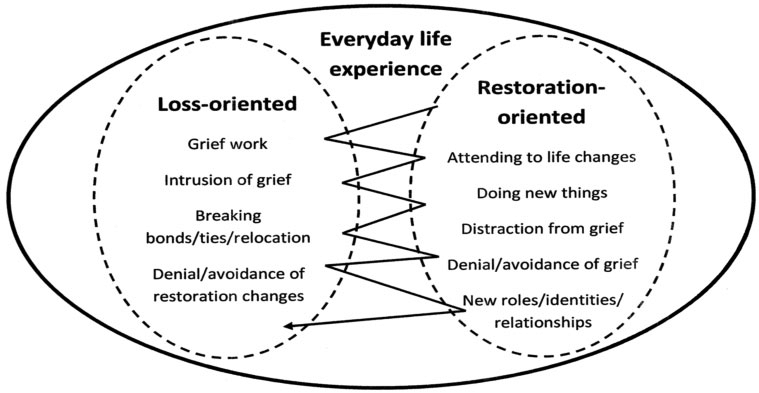
In reality most people do some of each, but in different proportions. This is known as the Dual Process Model of grief. (see below for more detailed explanation).
One thing we have found is that this can cause tension, particularly in extreme cases like the death of a child, but also perhaps a sibling or parent. One person may worry that the other will never emerge from the depth of the feelings. The other may feel the other doesn’t care because they have gone back to work and are trying to live normally.
With a couple, understanding this can help to relieve tensions and resentments.
Lois Tonkin’s model of grief acknowledges that the grief may never go away or lose its intensity, but as time goes on more of a life is built around it. So we don’t have to get over it, but we can build around it. There are times when that intensity will be acute, something will activate the grief like a memory or a scent, or it’s an anniversary. And at others we may forget for a while as we immerse ourselves in activities, new relationships, everyday life.
*********************
The dual process model of grief focuses on stressors linked to grief.
The 2 types of stressors here are ‘loss orientated’ and ‘restoration orientated’.
Both require coping. Taking breaks within this coping is essential for people within the grieving
process.
Examples of coping with loss
Restoration-orientated focuses on the demands of living after the loss. It can be isolating and
stressful learning new skills or tasks that the deceased person used to do.
These can involve:
• Cooking
• Financial affairs
• DIY
• Childcare
• Finding employment
• Household chores
Loss-orientated focuses on emotionally processing the loss of the person who has died.
This might involve:
• Memories
• Reminiscing
• Yearning
• Crying
• Imagining
Oscillation (moving backwards and forwards) between facing and avoiding the loss is a key part
of the dual process model.
This is viewed as a natural part of grief and presents a more accepting, holistic and inclusive
approach to working through it. Individuals can find a balance between facing loss and re engaging with life after loss